Huo Luo Swimming Pool
The HollowThe swimming pool at The Hollow is both a physical crossroads and the novel’s most charged crime scene. In a setting associated with leisure, open air, and the apparently innocent rhythms of country-house life, it becomes the place where John Christow is shot, where Gerda Christow is first seen holding a revolver, and where Hercule Poirot must learn that a scene can look staged without being unreal. The pool’s blue water, pavilion, surrounding woods, and converging paths turn space itself into an instrument of misdirection.
Setting and Spatial Structure
The pool lies in an open space reached through the chestnut woods. Beside it stands a small pavilion where members of the Angkatell household sit on bright days when the wind is cold. Paths approach the area from different directions: one rises from the farm, another comes through the woods by the left-hand route, a third descends from the long flower walk above the house, and the path beside the pavilion continues towards Podder’s Lane. The pool is therefore not an isolated enclosure but a visible meeting point at which several routes and lines of observation overlap.
That arrangement matters immediately after the shooting. Inspector Grange reconstructs the arrivals with precision: Lucy Angkatell came by the path below the pool from the farm; Edward Angkatell approached from the woods by the left-hand path; and Henrietta Savernake came separately by the right-hand path leading from the flower walk. Edward and Henrietta were both on the far side of the pool when Hercule Poirot arrived. The geometry promises clarity, yet the number of approaches creates competing possibilities about who saw what, who could have followed someone, and who might have reached the house unseen.
The house itself remains visually present through the open French window. After following Veronica Cray away from the drawing room, John Christow returns towards a house whose window has been left half open for him. The sleeping building appears innocent, but to John it looks too innocent; the pool and the house are connected by doors, paths, and imagined movements rather than by secure boundaries. A faintly heard door seems capable of explaining how a follower might return by a higher route and re-enter through the side garden door. The location thus produces uncertainty before the shot is fired: openness does not guarantee knowledge, and visibility does not prevent concealment.
The Shooting and the Apparent Scene
Veronica Cray reaches the pool after moving swiftly along the narrow path through the chestnut woods. She emerges into the open space by the pavilion, stops, and faces John Christow. Earlier, her entrance into the drawing room through the French window has already been described as dramatically unreal, like a stage entrance. Her arrival at the pool extends that theatrical pattern into the place where the novel’s central violence occurs.
John has just walked back slowly through the wood after rejecting Veronica. He sits on the bench by the pool and thinks that he has escaped the danger of his past. He regards Veronica as destructive and decides that ending their former entanglement was the best thing he had done. The encounter has also altered his view of his domestic and emotional life: he imagines becoming kinder to Gerda Christow and less inclined to bully Henrietta Savernake. The pool momentarily appears to offer a threshold into a new life, freed from old attachments.
That imagined future ends when John recognizes the click of the weapon. He turns quickly but not quickly enough. The shot rings out, and he falls awkwardly, sprawled at the edge of the pool. A dark stain spreads on his left side; blood trickles over the concrete and drips red into the blue water. The pool’s recreational surface is thereby marked by the physical evidence of death, while its carefully maintained appearance becomes inseparable from the murder.
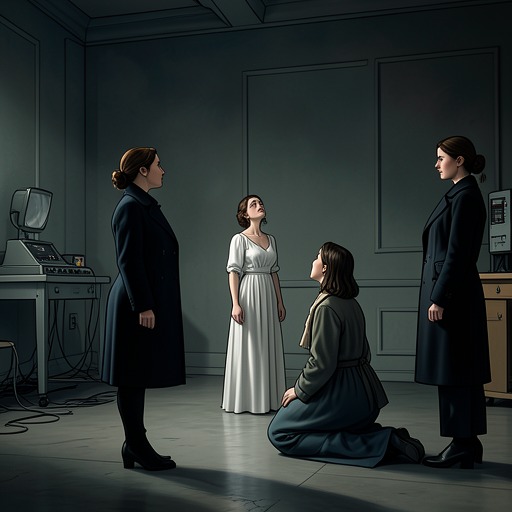
When Hercule Poirot reaches the open space, the scene initially seems too artificial to be credible. He sees John’s body arranged with an outflung arm and what appears to be red paint dripping over the concrete. Gerda stands over the body with a revolver and a blank expression. Across the pool are Henrietta, carrying a basket filled with dahlia heads; Edward, in a shooting coat and carrying a gun; and Lucy, holding a basket of eggs. Each figure appears to have arrived along a separate path, giving the tableau a mathematical, composed quality. Poirot assumes that the Angkatells have arranged an elaborate practical joke for him and resents being placed in the role of its intended audience.
The pool’s decisive reversal comes when Poirot realizes that the artificial scene contains a point of reality. The apparent paint is blood, and the handsome fair-haired man is not merely performing death but has been shot only a short time before. The scene’s theatricality does not cancel its truth; it becomes the means by which truth is initially disbelieved.
Investigation and Reconstruction
After the police surgeon and investigators have photographed, measured, examined, and removed John’s body to the mortuary, the pool looks curiously innocent again. Yet Poirot no longer sees it primarily as a swimming pool. It has become the place where John’s body lay and where his life blood ran over the concrete into artificially blue water. The ordinary identity of the location has been replaced by its forensic and moral identity, even after the physical traces have begun to disappear.
The revolver becomes the first major contradiction in the pool’s visual story. Inspector Grange expects Sir Henry Angkatell to identify it and supposes that Gerda took it from his study. The woman holding the weapon appears, at first glance, to be the shooter. Later, however, Poirot tells Grange that the gun in the tableau was not the weapon used to shoot John Christow. The pool scene therefore separates appearance from proof: the object most conspicuously displayed is precisely the object whose evidentiary meaning is false.
The location also becomes a site of repeated inspection. When Poirot later crosses the lane and hurries through the chestnuts, the pool is deserted because the police have finished their work. In soft, misty autumn light it looks peaceful and innocent. He looks into the pavilion and notices that the platinum fox cape has been removed, while six boxes of matches remain on the table beside the settee. Their presence seems incongruous in a damp pavilion; one box might be convenient, but six suggest deliberate placement or an unexplained connection. The pavilion extends the pool’s mystery beyond the body itself, preserving small material details after the principal spectacle has vanished.
The pool also remains visible from higher ground. On a later walk, Henrietta leads Poirot along a track rising towards the woods and then across a broader hillside path. They sit on a bench above the chestnut groves, while a curving path descends in front of them and only a glimmer of blue water can be seen below. From this elevated position the pool is reduced to a partial view, illustrating how distance and angle govern what witnesses can perceive. Its apparent openness depends on where an observer stands.
Symbolic and Narrative Significance
The pool is the clearest embodiment of the staged murder scene. Poirot later suspects that the arrangement was planned in advance because it resembled a stage scene: a recently shot man and the woman who appears to have shot him, revolver in hand. Yet the picture is wrong in a crucial respect, since that revolver did not fire the fatal shot. The location manufactures a legible story for its witnesses, then forces the investigation to dismantle that story piece by piece.
Its theatrical character is reinforced by entrances, exits, props, and spectators. Veronica comes through a window as though making an entrance; the victim lies in a deliberately spectacular posture; Gerda occupies the most conspicuous position with the gun; baskets of flowers and eggs give the surrounding witnesses the visual quality of actors bearing stage properties; and the separate paths provide controlled approaches to a common playing area. Hercule Poirot is not merely investigating the pool but interpreting a performance that has been designed to direct his attention.
At the same time, the pool resists complete theatrical control. Blood replaces paint, death interrupts the expected joke, and the apparent simplicity of the tableau conceals a more complex arrangement of actions and loyalties. At the end of the inquiry, Poirot explains to Henrietta that he sensed from the first that the scene had been set, although he did not initially understand that Gerda had staged it by acting a part. He later recognized that Henrietta’s ingenuity was the force opposing his investigation and that the family helped her once they understood what she wanted accomplished. The pool is consequently the visible surface of a collective act of protection: a place where a false account is presented so that the consequences of the true account may be contained.
The location’s final importance lies in the tension between innocence and memory. In daylight and mist, after the police have left, the water and surrounding woods can resume their peaceful appearance; but the pool cannot return wholly to its former function. It remains the point where John’s future ended, where the family’s protective fiction took shape, and where Poirot learned to distrust an image without dismissing the reality behind it. The swimming pool at The Hollow therefore converts a domestic amenity into the novel’s central theatre of perception, evidence, guilt, and concealment.